lumiies® Journal · Dog activities
Sniffing as an activity for dogs: why it matters so much

Dogs sniff all the time: at bushes, at the ground, at other dogs. Many people find it annoying. Yet sniffing is one of the most natural things a dog can do. It is not a hobby, it is a basic need.
Why is sniffing so important for dogs?
Smell is a dog's leading sense. Where we humans take in the world mainly through our eyes, dogs read their surroundings with their nose. For a dog, sniffing is what reading or solving a puzzle is for us: focused head work.
Active sniffing asks a lot of a dog mentally and is deeply satisfying at the same time. Many owners notice that after a long sniffing session their dog seems calmer and more settled than after physical exercise alone.

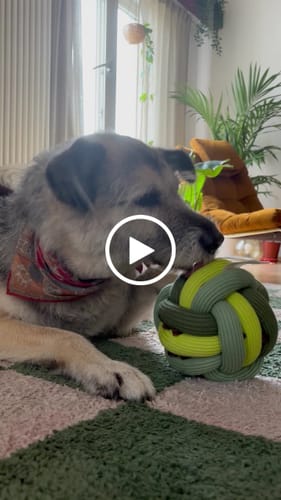
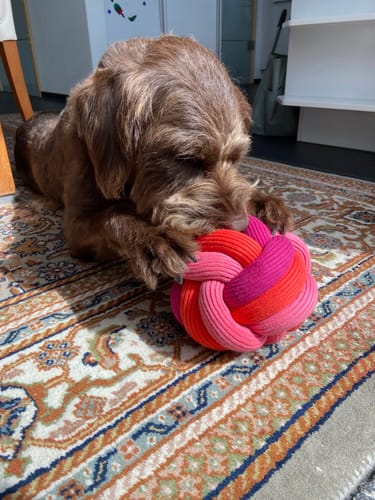
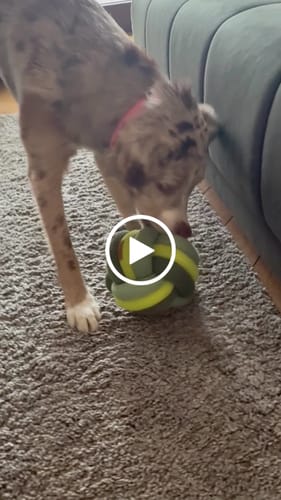
The lumiies® Twisty Ball, the snuffle ball for curious noses. Knitted from cotton.
Sniffing or walking: which matters more?
Many dog owners believe their dog mainly needs long walks. That is partly true. But mental stimulation through sniffing is a need of its own that physical exercise does not replace. The two work together.
A dog who walks for miles every day but is never allowed to sniff in peace often stays restless inside. The other way round, even a short, focused sniffing session can ask a lot of a dog, with no distance covered at all.
Good to know
Sniffing needs no equipment and no training. A snuffle ball like the lumiies® Twisty Ball makes starting out simple: hide treats, let your dog sniff, done. Every day, in any weather, indoors and out.


How do I encourage sniffing on purpose?
The good news: encouraging sniffing is easier than most people think. Here are five ways, from something you can start today to a class at dog school.
-
Snuffle ball
The simplest way in: hide dog treats between the fabric layers of a snuffle ball. The lumiies® Twisty Ball is 15 cm across, roomy enough for plenty of hiding places and small enough for any room.
-
Sniffing walk
On the walk, slow the pace right down and let your dog sniff wherever he likes, for as long as he likes. No pulling, no rushing. For the head this is often harder work than a brisk lap.
-
Search games indoors
Hide treats around the flat and let your dog search: under cushions, behind furniture, in corners. Free, ready straight away, suitable for any dog. You can raise the difficulty with trickier hiding places.
-
Snuffle mat
Hide treats between long strips of fabric, made for the floor and a good companion to the snuffle ball. Especially good for dogs who like to root about with their nose.
-
Nose work and mantrailing
Many dog schools offer nose work and mantrailing. Your dog learns to follow scent trails step by step. A natural next move for dogs who have really taken to sniffing.
A tip from practice
The snuffle ball also works for the daily feed: put the dry food into the Twisty Ball instead of the bowl. Your dog works for his meal, eats more slowly and is busy and content afterwards.
Which dogs benefit most from sniffing?
In principle every dog gains from regular sniffing. For some breeds and in certain situations it pays off especially well.
Hunting and working dogs
Beagles, dachshunds, Weimaraners and other hunting breeds were bred for nose work. Their need to sniff is correspondingly strong. Without regular sniffing tasks these dogs often find their own occupations, and not everyone enjoys those.
Dogs in a city flat
Dogs without a garden have fewer chances to sniff freely out in nature. A snuffle ball at home is a good counterweight: no distractions, full focus on the nose.
Older dogs and quieter spells
In old age, or when a lot of movement is not possible just now, the head stays active and still wants something to do. Gentle sniffing works without physical strain, at your dog's own pace, in his own spot.
The Twisty Ball
The snuffle ball for curious noses. Hide treats or dry food between the fabric layers, let your dog sniff, enjoy it together. In three colours: Berry, Matcha and Ocean Twist.
Frequently asked questions about sniffing
Why do dogs sniff so much?
Sniffing is a dog's main way of taking in the world, much as sight is for us. It is not bad behaviour but a basic need, and one you are welcome to encourage.
How often should my dog be allowed to sniff?
Every day is ideal. Short, regular sessions make more sense than rare long ones, because the head needs rest too. Watch your dog: he will show you when he has had enough.
What is a snuffle ball and how does it work?
A snuffle ball is a dog toy with treats hidden between its fabric layers. The dog has to sniff, search and find in order to reach the reward. The lumiies® Twisty Ball is made from double knitted cotton and is machine washable at 30°C.
Is a snuffle ball also a chew toy?
No. The Twisty Ball is made for sniffing and searching, not for chewing. It is not suitable for strong chewers. Please always supervise your dog while he plays and take the ball away if it is damaged.
Can I use the snuffle ball for feeding?
Yes, and that is one of its most useful jobs. Put dry food into the ball instead of the bowl: your dog works for the meal, eats more slowly and stays busy for longer. A good idea for dogs who tend to bolt their food.
How do I wash the Twisty Ball properly?
At 30°C on a delicate cycle with a mild detergent for coloured laundry, ideally inside a wash bag such as the Gentle Wash Bag. Then hang it up to dry. Do not use a detergent containing bleach.
In short
Sniffing is not bad behaviour, it is one of the loveliest things your dog can do every day. Encourage it actively, with sniffing walks, search games and a snuffle ball. The lumiies® Twisty Ball is the simplest way in: every day, in any weather, for small dogs and large ones.
To the Twisty Ball